Blog / Modes & builds
Poke Survivor Expeditions vs Classic: Ten-Minute Runs Explained
Compare Poke Survivor Expeditions with classic survival: four automatic skill slots, two equipment slots, resonance builds, guardian deadlines and clear rewards.
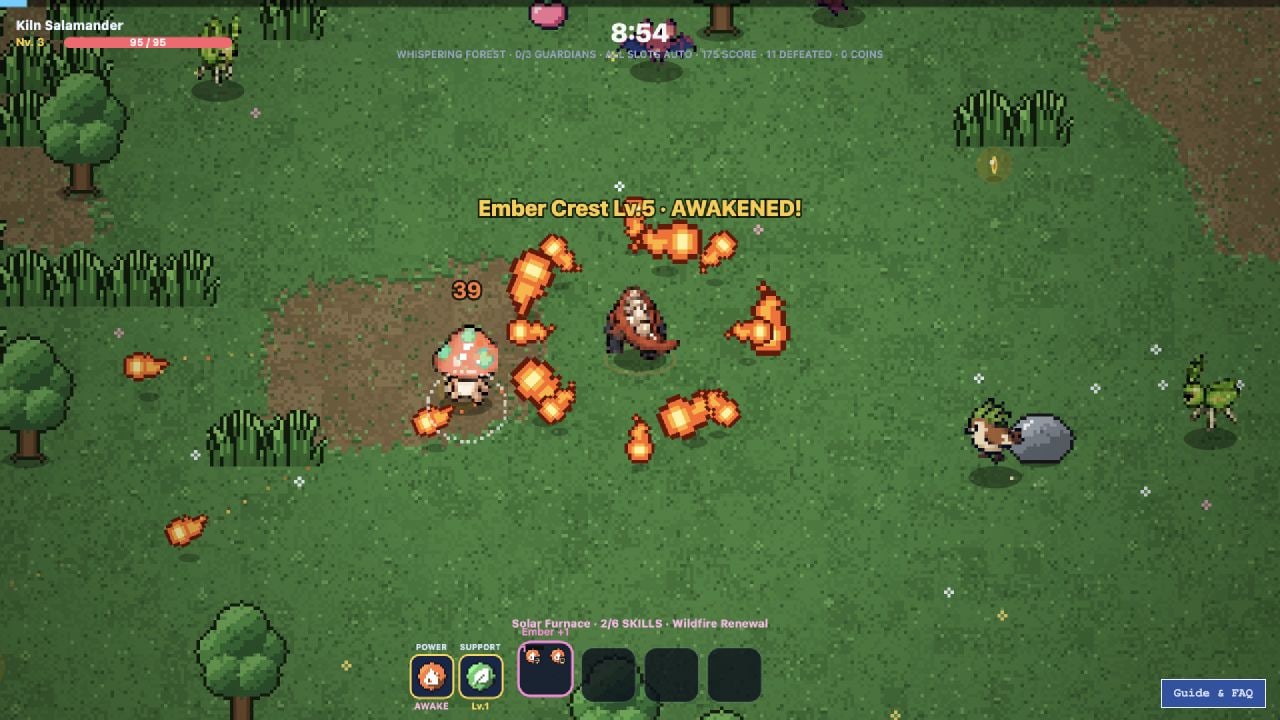
Expeditions give a survival run a finish line
Wildlands Expeditions is the stage-based mode in the free browser game at https://pokesurvivor.app/. Classic survival asks how long you can stay alive and how far you can push your score. Expeditions asks whether you can assemble a working build and defeat three guardians before 10:00.
Both modes use movement, automatic attacks, experience pickups and level-up choices. The difference is how those pieces fit together. Four skill slots attack together in Expeditions, two equipment slots support a build, and each map ends with a clear or a failed attempt. You rebuild for the next map instead of carrying an increasingly powerful run through a continuous campaign.
Classic survival and Expeditions: the current rules
| Decision | Classic survival | Wildlands Expeditions |
|---|---|---|
| Goal | Survive longer and improve your score; defeating the third main boss does not end the run | Defeat three guardians before the ten-minute limit |
| Attacks | The selected slot attacks automatically; bonded moves in that slot fire together | All four slots attack automatically on their own cooldowns; the selected slot becomes your core |
| Equipment | One held item | One power item and one support item |
| Map | Explore a world with changing biomes and optional rift arenas | One fixed map theme per stage, with terrain generated for the run |
| Build payoff | Strengthen an active attack or linked slot; adapt when you switch | Combine linked skills, a catalyst and extra resonance attacks |
| Progress | Keep normal earnings, discoveries and permanent progress | Keep those plus verified clear bonuses, first-clear tickets and the next map unlock |
| Next attempt | Start a fresh run | Start a fresh build on the same stage or a newly unlocked map |
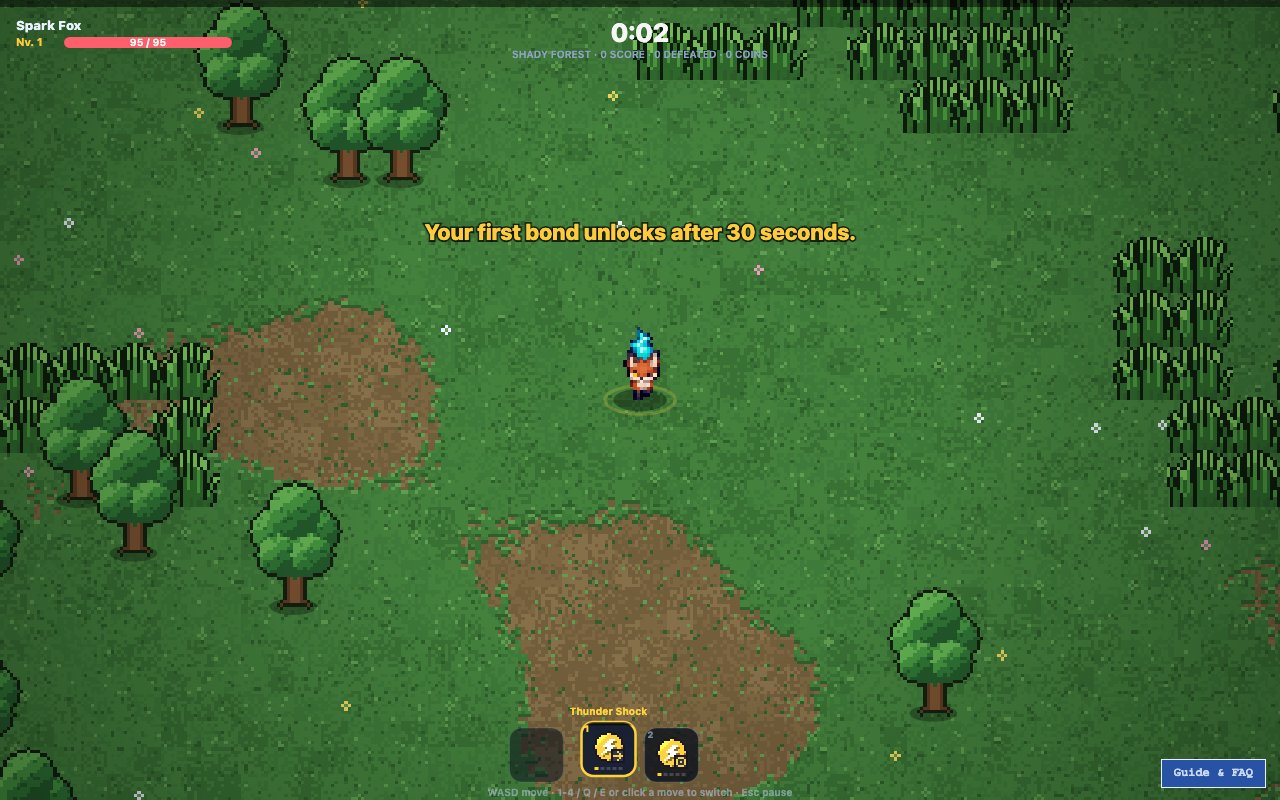
Four automatic slots make the whole build matter
In classic survival, selecting another slot changes which attack fires. A bond lets several moves share that active slot. In Expeditions, every occupied slot fires when it can find a valid target. Selecting a core does not turn the other slots off; it changes how parts of your build are emphasized.
Move bonds still matter because they compress attacks into one slot. Expeditions allows one linked group of up to three moves and at most six learned moves in total. To activate one of the nineteen named resonances, link its matching pair, raise both ingredients to at least level 3, and equip a listed catalyst. The recipe adds an extra attack alongside the ingredient moves; a third linked move empowers it.
For a forest example, work toward Solar Furnace: bond Ember with Fire Spin, upgrade both to level 3, and use Ember Crest as the catalyst. Pairing Ember Crest with Moss Heart also activates Wildfire Renewal, a separate equipment-set effect. The resonance and the set have different requirements: owning the items alone does not complete the move recipe. Check the recipe table and equipment reference before spending a choice.
The forest offers equipment from 0:20 and a bond opportunity at 0:30 when you have two unlinked moves. Its guidance tracks the linked pair, both move levels and the catalyst. This makes the opening about reaching a useful combination before the first guardian, rather than simply filling every slot.
Equipment grows during a run, and helps your partner grow
The latest equipment update applies to classic survival and Whispering Forest. Collect the same equipped item or choose its upgrade card to raise it from level 1 to level 5. Each item has a special awakening at level 5: for example, Ember Crest gains an extra burning nova, while Life Orb removes its health cost.
Equipment upgrades to levels 2–4 each award experience equal to 35% of a partner level; reaching level 5 awards one level of experience. You still make the normal level-up choices. This grows the partner within the current run; it does not automatically evolve the creature’s form or purchase a permanent upgrade.
Classic has room for one item, so choosing damage, recovery or utility is a tradeoff. The forest’s power/support pair can also complete one of four equipment sets: Wildfire Renewal, Storm Conductor, Blood Pact or Hunter’s Bastion. Item ranks survive swaps within that run and reset for the next run. Cavern and volcano currently retain their earlier equipment rules; this awakening system has not been extended to those maps.
The illustrated equipment update lists the six new items and the full scope of the changes.
Ten minutes is a deadline, not a required waiting time
Guardians are scheduled at 3:00, 6:00 and 9:00. Defeat all three before 10:00 to clear. The final guardian’s defeat ends the stage immediately, so a successful run can finish before the timer reaches ten minutes. Surviving until the deadline without defeating all three is not a clear.
Guardian phases add pressure through barriers and marked ground attacks. Forest root circles and later beam lanes ask you to keep a route open while your arsenal attacks. A stronger build helps, but standing inside a warning area can still end the attempt.
Classic main bosses and forest guardians now expose a weak point after you deal damage equal to 15% of their maximum health: incoming damage rises by 25% for three seconds, with a twelve-second re-arm cooldown. This creates a short damage window. Rift bosses, cavern and volcano keep their existing balance and do not receive this new break mechanic.
A clear pays rewards and opens a map, then the build resets
| Map | Entry requirement | First-clear total | Repeat-clear bonus |
|---|---|---|---|
| Whispering Forest | Available from the start | 400 coins + 2 single-draw tickets | 100 coins |
| Echoing Cavern | Clear the forest | 650 coins + 3 single-draw tickets | 150 coins |
| Ashen Volcano | Clear the cavern | 1,000 coins + 5 single-draw tickets | 200 coins |
The first-clear totals already include that map’s repeat-clear bonus; they are not two separate first-clear payments. First-clear bonuses are granted once per map and player profile. A failed attempt keeps normal earnings and discoveries but does not grant the clear reward or next-map unlock. If a result is waiting to sync, keep the browser copy and reconnect so the service can verify it.
Opening the next map starts you at run level one with a fresh move build and empty equipment slots. Your collection, encountered forms, permanent partner upgrades, currency and map unlocks remain. A forest build is therefore one successful answer to that stage, not equipment you must carry into every later map.
Both modes also support two-player and four-player rooms. Classic solo, classic team and Expedition records have separate boards; Expedition records distinguish the map and party size.
Choose the mode for the kind of session you want
Choose classic survival if you enjoy exploring, switching your active slot, taking optional rifts and extending a score run. Choose Expeditions if you want a defined objective, several simultaneous attacks and a reason to assemble a specific combination before a deadline. Whispering Forest is the first stage and the current home of the expanded equipment sets.
For a first forest attempt, choose a compatible move pair, link it, follow the level-3 checklist and keep its catalyst. Add recovery or defense in the support slot, and move out of guardian warnings even when a damage window opens. You can retry the stage with a different partner or combination; unlocking the next map does not remove the earlier one.
These are the rules available today. Additional maps, challenges and creatures will be described in the release notes when confirmed. For controls, saves and your first classic run, start with the beginner’s illustrated guide.