Blog / Inside Wildlands
Why Poke Survivor Uses Original Creatures
A look at the October 17 Wildlands edition: original creature art, survival builds and an evolving world, with links to the current Poke Survivor overview.
Release snapshot · October 17, 2026. This article describes the 315-form Wildlands release. For the current roster and all three routes, read our updated Poke Survivor overview.
A familiar survival loop, with an original world to discover
Move through a crowd, collect experience and turn a small opening attack into a strong build. That loop makes creature survival games easy to start and interesting to replay. At pokesurvivor.app, Poke Survivor: Wildlands builds on it with an original creature cast, two distinct modes and progression between runs.
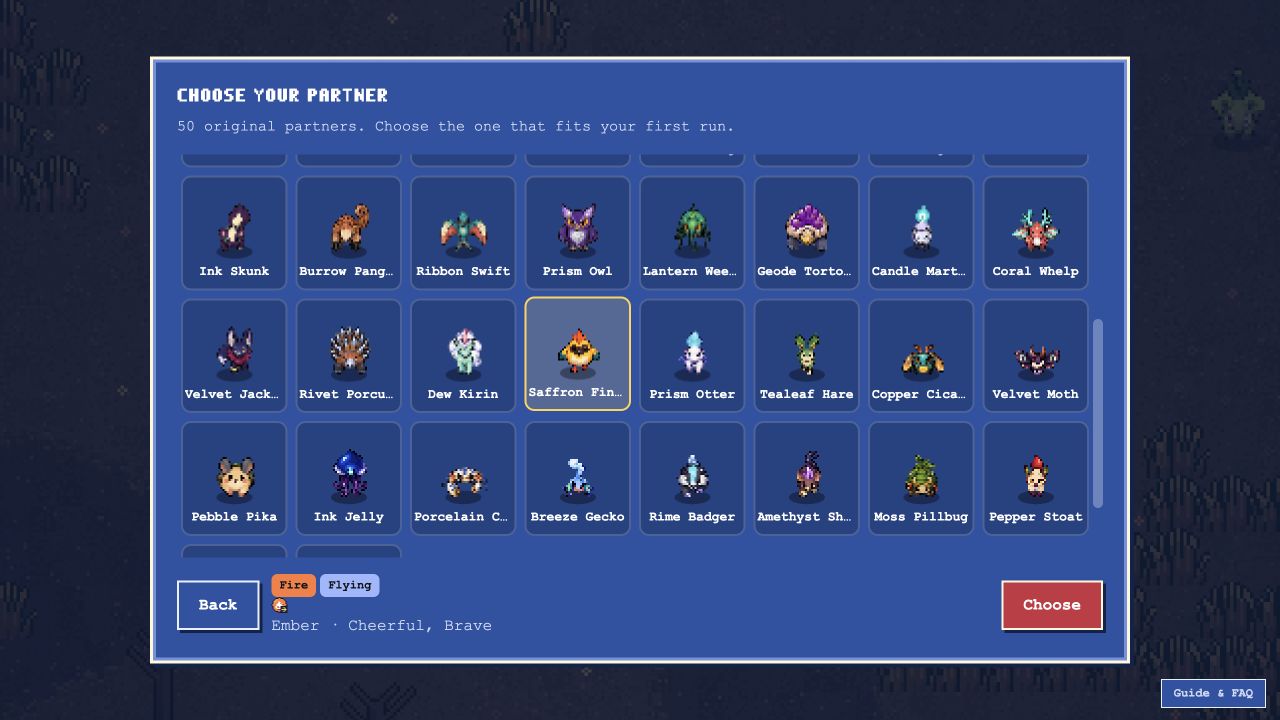
If you are comparing Pokémon-inspired survival sites, the useful question is what each edition actually adds. Wildlands focuses on an original world and new rules that give you reasons to make another run. It is an independent, unofficial project with its own creature artwork, including AI-generated art, rather than imported Pokémon character images. The game also retains attribution for its MIT-derived engine code.
The current roster contains 315 creature forms, with 50 starting partners available in the selection screen. Those numbers describe different things: a starting partner is a way to begin a run; an enemy or evolved form is something you can encounter and discover. The latest expansion adds new partners as well as separate evolution families, with walking, attacking and hit animations.
Two modes give the same move library different purposes
Classic survival is for a longer adventure. One selected skill slot attacks automatically, so switching slots and bonding attacks changes how you handle a crowd. Boss encounters now reach the twelve- and fifteen-minute marks. Endless survival remains available, with an optional solo Eclipse Trial after thirty minutes.
Expeditions offer a shorter, directed challenge. Each map lasts ten minutes, all four skill slots attack automatically and two equipment slots support a build. Three guardians must fall before the deadline. A confirmed clear unlocks the next chapter; your next map starts with fresh skills and equipment, so the next run is a new construction rather than a carried-over finished build.
| Design choice | What you can do with it |
|---|---|
| Classic and Expeditions | Choose a long score run or a ten-minute chapter with a clear objective. |
| Bonds, evolutions and resonance | Plan how attacks share slots, grow stronger and interact with equipment. |
| Personal discoveries | Reveal a form by meeting it, instead of reading the entire creature catalog first. |
| Original world and artwork | Meet a cast made for these maps and follow new chapters as they are developed. |
These are features of this edition, not a claim that every other survival game lacks them. If you want the exact rules before choosing, read the classic guide and Expedition guide.
A build is more than a list of attacks
Several choices work together. A bond places attacks in one group. A move evolution requires a fully developed move and its matching stat card. Expedition resonances add recipes with their own bond, skill-level and catalyst conditions. Planning one system does not automatically complete the others.
For example, Whispering Forest can combine Ember and Fire Spin in a bonded slot. At the required levels and with an accepted catalyst, that pair can awaken Solar Furnace. Your power and support items can also form a separate equipment set. A good plan therefore includes the path to the recipe, the equipment you need and enough defense to survive while assembling it.
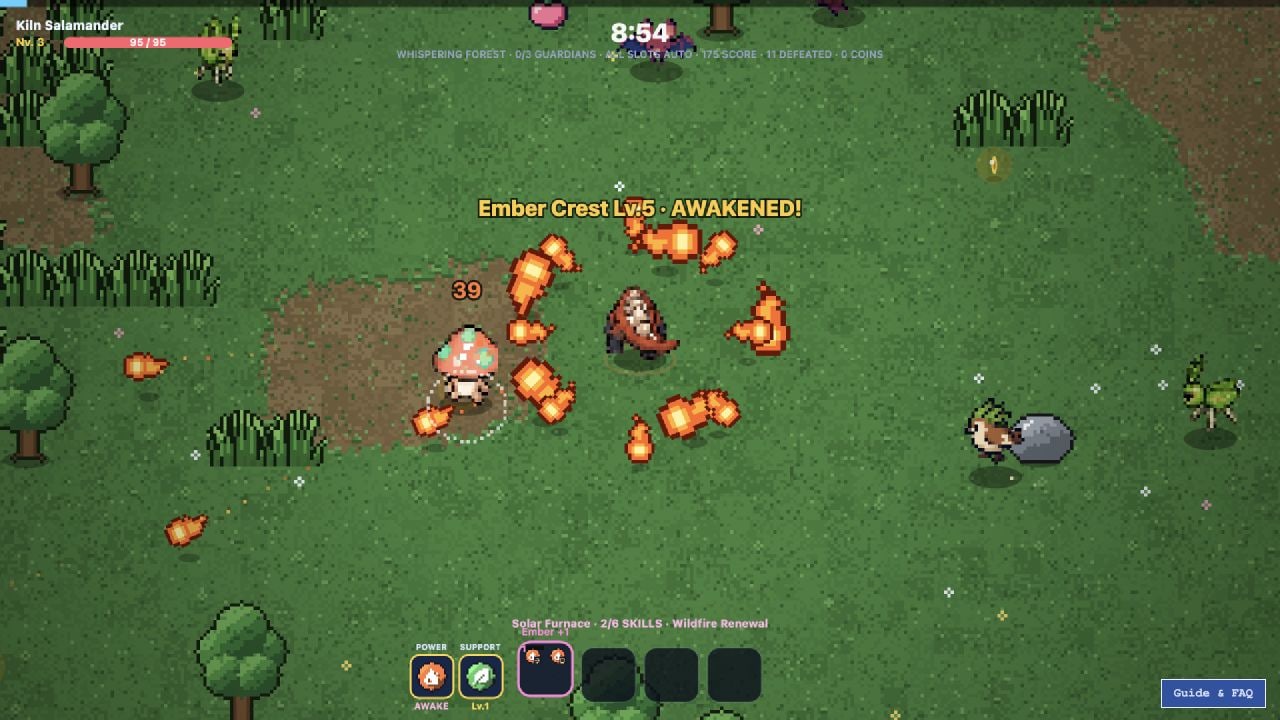
Duplicate equipment can reach Lv.5 and awaken in classic survival and the forest. The cavern and volcano keep their original Lv.1 equipment rules. Permanent partner upgrades, including critical-hit growth, give returning players another way to develop a favorite partner. The public build planner helps check these mode-specific requirements and share a plan without sharing a private collection.
Keep the surprise in a growing collection
A personal atlas makes discovery part of the adventure. Unknown creatures appear as silhouettes with question marks. Their descriptions and attributes unlock when encountered, and each evolved form needs its own encounter. Meeting a base creature does not reveal the rest of its family.
Between runs, earned tickets can go into the original Wildlands pool or one of nine ecology pools. The focus pools help aim lower-rarity draws toward a pair of types while keeping their displayed guarantee progress separate. Twenty species also have original alternate colors with full motion sets. They are cosmetic variations of existing species, rather than twenty additional species or a hidden statistical advantage.
That creates several possible goals: improve a partner, discover an unfamiliar form, complete a forest build or hunt a different color. You do not need to pursue all of them in the same session.
Original content gives us room to write the next chapter
Building an original cast lets our development team choose how this world grows. We can write creature relationships, connect a map to its own guardians and rewards, and develop a visual identity across future chapters. That freedom is one reason to create a distinct edition rather than keep its content fixed to a reused roster.
Today, the playable chapters are Whispering Forest, Echoing Cavern and Ashen Volcano. Their routes and rules are authored by the team. A player-facing story editor, custom-map builder and creature-upload tool are not available. When we talk about setting our own storylines, we mean the team’s ability to design future content.
Our direction is to develop those connections between maps, creatures, equipment and objectives, and use feedback and gameplay observations to improve the experience. New stories, additional chapters and future roster expansions will be described in release notes when ready; this article does not announce a schedule or a further creature count.
Start with the kind of adventure you want
Choose classic if you enjoy adapting one active attack group and seeing how far a build can go. Choose the forest if you want four simultaneous attack slots, a resonance recipe and a ten-minute target. Two- and four-player rooms give you another way to explore with friends.
Play free in your browser at https://pokesurvivor.app/. For a tour of everything currently shipped, continue to our current-version overview; for the detailed history, use the release notes.